
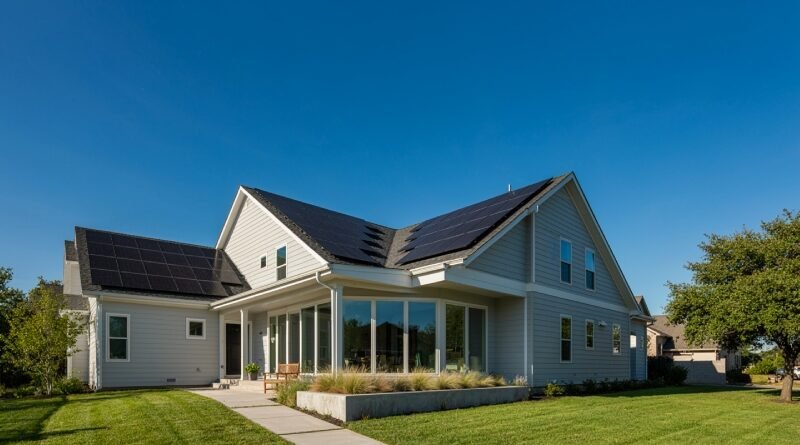
How Many Solar Panels Do You Need for a 2000 Sq Ft House?
Most 2000 square foot homes need between 15 and 25 solar panels to cover all of their electricity. The exact number depends less on the size of your house and more on how much power you use, where you live, and which panels you choose. This guide shows you how to work out your own number in a few minutes.
Quick Answer
If your home uses about 900 kWh of electricity a month, which is close to the US average, you will need roughly 18 to 19 panels rated at 400 watts each. Homes with electric heating, a pool, or an EV charger can need 25 panels or more.
Solar Panels Needed by Monthly Usage
The table below assumes 400W panels and about 5 peak sun hours per day.
| Monthly Usage (kWh) | System Size | Panels Needed (400W) |
|---|---|---|
| 600 | ~4.5 kW | 11-12 |
| 900 | ~6.5-7.5 kW | 17-19 |
| 1,200 | ~8.5-10 kW | 21-25 |
| 1,500 | ~10.5-12 kW | 26-30 |
These are estimates. Your own utility bill will give you the real starting point.
What Decides How Many Panels You Need
1. Your electricity usage. This is the biggest factor. A 2000 sq ft home with gas heating and modest appliance use may need only 12 to 15 panels. The same house with a heat pump, electric water heater, and two EVs may need double that.
2. Peak sun hours. This is the number of hours per day when sunlight is strong enough for full panel output. Arizona gets about 6 or more, while parts of the Northeast and Pacific Northwest get closer to 3.5 to 4. Fewer sun hours mean you need more panels for the same output.
3. Panel wattage. Modern residential panels range from about 350W to 450W. Higher-wattage panels mean fewer panels, and they suit small roofs.
4. Roof direction, angle, and shade. South-facing roofs (in the US) with a tilt of 15 to 40 degrees perform best. Shade from trees or chimneys can reduce output noticeably.
5. System losses. Real systems lose around 15 to 20 percent to inverter conversion, wiring, heat, and dust. Good calculations always include this.
How to Calculate Your Solar Panel Needs (Step by Step)
Step 1: Find your annual usage. Check your utility bills and add up 12 months of kWh. Or multiply your average monthly usage by 12.
Step 2: Find your peak sun hours. Use NREL’s free PVWatts calculator (pvwatts.nrel.gov) and enter your address.
Step 3: Use this formula.
System size (kW) = Annual kWh ÷ 365 ÷ peak sun hours ÷ 0.8
Step 4: Divide by panel wattage.
Number of panels = System size (kW) ÷ panel wattage (kW)
Worked example:
- Usage: 10,800 kWh per year (900 kWh/month)
- Daily need: 10,800 ÷ 365 = 29.6 kWh
- With 5 sun hours and 0.8 efficiency: 29.6 ÷ 5 ÷ 0.8 = 7.4 kW
- With 400W panels: 7.4 ÷ 0.4 = about 19 panels
How Location Changes the Answer
Take the same 900 kWh/month home in different states.
- Arizona (about 6 sun hours): roughly 15 panels
- Texas or Florida (about 5 to 5.5 hours): roughly 17 to 19 panels
- New York (about 4 hours): roughly 23 panels
- Washington (about 3.5 hours): roughly 26 panels
The house is identical in each case. Only the sunlight changes.
Will the Panels Fit on Your Roof?
A standard residential panel measures about 65 by 39 inches, which is roughly 17.5 square feet. Nineteen panels need about 330 to 350 square feet of usable roof space. A typical 2000 sq ft home has enough roof area, but dormers, vents, skylights, and shaded sections reduce usable space.
If space is tight, choose higher-efficiency panels of 420W or more. They produce more power from the same area, though they cost more per panel.
How Much Does It Cost?
Residential solar in the US has commonly cost around $2.50 to $3.50 per watt before incentives. For the 7.4 kW example above, that is roughly $18,500 to $26,000. Prices vary by installer, state, equipment, and roof complexity.
Incentives matter a lot here, and they have changed recently. Federal residential solar tax credit rules were revised, so check the latest details at energy.gov before you plan around them. Many states and utilities also offer their own rebates, net metering, or property tax exemptions. The DSIRE database (dsireusa.org) lists them by state.
Tips to Reduce the Number of Panels You Need
- Cut your usage first. LED lighting, better insulation, and efficient appliances lower the system size you need.
- Choose higher-wattage panels if roof space is limited.
- Fix shading problems by trimming trees before installation.
- Consider microinverters or optimizers if part of your roof is shaded.
- Size for future needs. If you plan to buy an EV or heat pump, add capacity now, since expanding later costs more.
Do You Need a Battery?
Not necessarily. If your utility offers net metering, the grid acts as your storage and a battery is optional. A battery makes sense if you face frequent outages, if your utility pays little for exported power, or if you want backup during emergencies. Batteries add several thousand dollars to the total cost.
Frequently Asked Questions
How many solar panels does it take to run a whole house?
For an average US home, about 15 to 25 panels of 400W. Your own bills give the exact figure.
Can 10 solar panels power a house?
Ten 400W panels make a 4 kW system, which produces roughly 500 to 600 kWh per month in sunny areas. That can cover a small, efficient home but not most 2000 sq ft houses.
How many kWh does a 2000 sq ft house use?
Usually 800 to 1,300 kWh per month, depending on climate, heating type, and household habits.
How much roof space do I need?
About 15 to 20 square feet per panel, so around 300 to 400 square feet for a typical system.
How long do solar panels last?
Most come with 25-year performance warranties and often keep working beyond that, with output declining slowly, around 0.5 percent per year.
Final Thoughts
For most 2000 sq ft homes, the answer is between 15 and 25 panels, with about 19 being typical at average usage. The best way to get a precise number is to gather 12 months of electric bills, run your address through PVWatts, and compare quotes from at least three installers.
This article is for general information only. Costs, incentives, and production vary by location and installer, so confirm details with a qualified solar professional.