
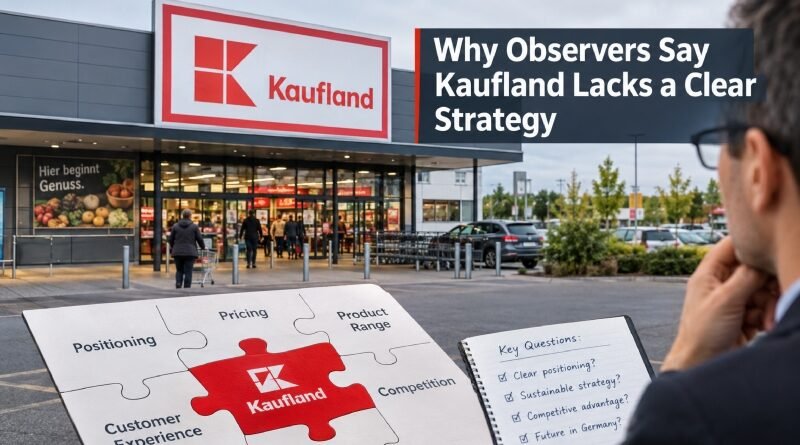
Why Observers Say Kaufland Lacks a Clear Strategy
Kaufland faces an uncertain future in Germany as questions grow about its long-term business strategy. Despite its strong market presence and steady sales growth, retail experts believe the supermarket chain needs a clearer identity. The latest change in German leadership has added another layer of uncertainty, raising questions about the company’s direction and its ability to compete in an increasingly crowded retail market.
Kaufland’s Stores Reveal Two Different Stories
A visit to Kaufland stores in Fulda and Gelnhausen can feel like stepping back in time. Worn flooring, plain shelves, and poorly organized product displays create an experience that does not always match modern shopping expectations. In Gelnhausen, for example, finding a cordless screwdriver advertised in a promotional leaflet reportedly proved difficult. Although the Parkside product section attracted attention, damaged packaging and disorganized displays made the shopping experience less appealing.
However, Kaufland has shown that it can deliver a very different retail experience. Its Waiblingen store, developed on a former Real supermarket site, features a modern layout, a strong fresh-food department, and a wide selection of organic and regional products. Parkside products also receive a dedicated display area that resembles a specialized home-improvement store.
These contrasting locations illustrate one of Kaufland’s main challenges. The company has the space, resources, and product range to operate successful large-format supermarkets, but it does not deliver the same experience consistently across its stores.
Strong Sales but Questions About Customer Value
Kaufland remains a major player in Germany’s large-format grocery retail market. According to the figures cited in the original report, the Schwarz Group operated 794 self-service hypermarkets in Germany in 2025. Kaufland’s estimated net sales increased from €21.25 billion in 2024 to €21.80 billion in 2025.
Market research figures cited in the report also indicate that sales increased by approximately 2% during the first half of 2026. By comparison, Globus recorded roughly half that growth over the same period.
Kaufland also attracted a much larger customer base. During the first half of 2026, approximately 23.9 million shoppers purchased from Kaufland, compared with 5.1 million at Globus. Kaufland customers made an average of 24.5 shopping trips, while Globus customers averaged 14.6.
The average spending per transaction showed a different pattern. Globus recorded an average basket value of around €43, compared with €34.40 at Kaufland. These figures suggest that Kaufland plays a stronger role in regular grocery shopping, whereas Globus attracts more customers looking to complete larger shopping trips.
For Kaufland, the challenge is not simply attracting shoppers. It is establishing a clear reason for customers to choose its stores beyond price and product variety.
Where Does Kaufland’s Customer Value Come From?
Kaufland has traditionally positioned itself as a large-format discount retailer, combining competitive prices with an extensive product selection. However, retail experts question whether this combination provides a sustainable advantage.
Carsten Kortum, a university professor specializing in retail, argues that Kaufland’s strategy creates a difficult balance. Customers expect low prices, but they also expect a broad assortment of products. Maintaining both advantages can increase operational complexity and make cost control more difficult.
The company must manage large stores, extensive inventory, logistics, staffing, and promotional campaigns while remaining competitive on price. As the range expands, maintaining profitability becomes more challenging.
A former associate of Klaus Gehrig, the former head of the Schwarz Group, also suggested that generating sufficient profits from the Kaufland format has become increasingly difficult.
These concerns raise an important question: can Kaufland continue offering both low prices and a wide assortment without weakening its profitability?
Another Leadership Change Raises Concerns
Kaufland’s leadership changes have added to the uncertainty surrounding its German operations. Stefan Hoppe left his position as Germany’s chief executive, and Ivan Chernev, a Bulgarian retail executive, became the next leader tasked with improving the business.
According to the original report, Chernev represents the fifth attempt since 2019 to achieve a lasting turnaround in the German large-format business.
However, retail specialists argue that repeated leadership changes may reflect a deeper strategic problem rather than individual management failures. Stephan Rüschen, a retail expert, believes that the situation points toward an unresolved business concept rather than a simple leadership issue.
Several managers have held senior positions at Kaufland without delivering a lasting breakthrough. This raises questions about whether the company has given its leaders a sufficiently clear strategy to implement.
Experts Question Kaufland’s Competitive Position
Martin Fassnacht, a prominent strategy expert, takes a particularly critical view of Kaufland’s position in Germany. He argues that the company lacks a distinctive competitive advantage between discount retailing and traditional full-service supermarkets.
In his assessment, Kaufland occupies an uncertain middle ground. Aldi and Lidl compete strongly on discount pricing, while Edeka and Rewe offer broader traditional supermarket experiences.
Other retailers also compete for specific parts of the shopping basket. Action attracts customers through non-food products, dm and Rossmann specialize in drugstore goods, and Amazon competes in online retail.
This creates a difficult situation for Kaufland. Its broad assortment may appeal to customers, but shoppers can often find individual categories elsewhere with a more specialized shopping experience.
Fassnacht argues that the Schwarz Group should reconsider the future of the Kaufland format in Germany. He suggests concentrating on markets where the concept performs well, particularly in Eastern Europe, and directing more digital expansion toward Lidl, which has a stronger discount-retail identity.
These comments represent his strategic assessment rather than an established decision by the Schwarz Group.
The Pressure of Promotional Discounts
Another challenge concerns Kaufland’s long-standing promise of offering many products under one roof. Johannes Berentzen, a strategy and management consultant, argues that this proposition has lost some of its appeal as retail parks and specialist stores have become more common.
Customers can now visit separate retailers for groceries, personal care products, pet supplies, clothing, and household goods. This reduces the advantage of purchasing everything in one large store.
The original report states that the market share of self-service hypermarkets declined from 12.6% in 2020 to 11.5% in 2025. This trend highlights the pressure facing large-format retailers as shopping habits and retail competition change.
Berentzen views Parkside, the Schwarz Group’s home-improvement brand associated with Lidl, as a useful opportunity for Kaufland. Giving the brand a recognizable presence in Kaufland stores could strengthen the retailer’s non-food offering.
However, improving product displays alone cannot solve the larger strategic problem. Kaufland still needs to define what customers should expect from the brand in the future.
The integration of 125 former real locations, involving approximately 9,000 employees, also placed substantial demands on the company’s management resources. According to Berentzen’s assessment, Kaufland focused heavily on growth and integration while leaving important questions about its future customer proposition unresolved.
Customer Reviews Highlight Areas for Improvement
Customer satisfaction presents another concern. The original report cites an analysis by data specialist Quantiquest, covering approximately 1.6 million Google reviews across 8,853 supermarkets.
In that analysis, Kaufland received an overall satisfaction score of 3.65, placing it behind all the full-assortment supermarket chains included in the comparison.
Quantiquest’s managing director, Volker Bernhardt, explained that Kaufland performed reasonably well in perceived value for money, receiving a score of 3.9. However, its results were weaker across most other evaluation factors.
This suggests that competitive pricing remains an important strength, but it may not fully compensate for shortcomings in other aspects of the customer experience.
One industry expert described Kaufland as relying heavily on promotional offers to attract shoppers. Reducing these promotions could lower store traffic, while narrowing the assortment could weaken the retailer’s appeal.
As a result, Kaufland faces a difficult balancing act. The company must improve its operations without undermining the factors that encourage customers to shop there regularly.
What Should Kaufland Change?
Despite these concerns, not every retail expert believes Kaufland’s business model is fundamentally threatened.
Berentzen has outlined several areas where the company could improve its performance. These include strengthening fresh-food departments, developing clearer private-label positioning, using Lidl-associated brands to improve the non-food assortment, and optimizing stores that no longer perform efficiently.
Under this approach, future growth would not necessarily depend on opening more locations. Instead, Kaufland could focus on making its existing stores more productive and appealing.
Stephan Rüschen, however, cautions against assuming that Ivan Chernev’s experience in Bulgaria will automatically translate into success in Germany. Differences in market conditions, store sizes, and locations make it difficult to apply the same operating model everywhere.
Kortum also argues that previous German leaders should not automatically be blamed for the company’s difficulties. According to the report, Hoppe introduced changes involving the Kaufland Card, marketing, drugstore products, store renovations, and fresh-food offerings.
Many of these initiatives require time to produce measurable results. Kortum notes that giving a manager only one year may not allow enough time for the full effects of strategic changes to become visible.
Why Kaufland Changed Its Promotional Leaflet Schedule
Even relatively small operational decisions have highlighted the company’s uncertainty about its direction.
One example is the timing of Kaufland’s weekly promotional leaflet. The company experimented with different distribution days and promotional schedules before returning to the traditional Monday offer launch.
Changing the schedule affects logistics, production, staffing, marketing reach, and sales planning. Although the alternative schedule offered some operational advantages, it reportedly confused customers who were accustomed to receiving promotional information over the weekend and seeing offers begin on Monday.
Experts generally consider the return to Monday a reasonable decision. Nevertheless, they also emphasize that changing the leaflet schedule will neither solve Kaufland’s larger strategic challenges nor significantly damage the business by itself.
The episode illustrates the difference between operational improvements and a genuine long-term strategy.
Could Kaufland Close Some Service Counters?
Questions about Kaufland’s future also extend to its in-store services. The original report mentions industry rumors that the retailer might close a low three-digit number of staffed service counters.
Such closures would represent a significant change for customers who value personal service, particularly in departments that traditionally distinguish full-service supermarkets from discount retailers.
A Kaufland spokesperson rejected the suggestion that the company was planning a broad closure program. The spokesperson explained that the retailer continually reviews its operations and may reconsider individual service counters at particular locations.
Accordingly, the reported possibility of widespread closures should not be treated as a confirmed company decision.
If Kaufland reduced staffed services substantially, however, the change could further influence how customers perceive its position relative to Edeka and Rewe.
Kaufland Needs a Clear Long-Term Strategy
The central question is whether Kaufland can establish a convincing identity in Germany’s competitive grocery market.
The company has considerable strengths, including its extensive store network, large product assortment, established customer base, and competitive pricing. Its recent sales performance also indicates that the business continues to attract shoppers.
However, these advantages do not automatically guarantee long-term success. Kaufland must decide whether it wants to compete primarily as a discount retailer, a full-assortment supermarket, or a distinctive combination of the two.
Its new German leadership will need to translate that decision into consistent store layouts, clearer product priorities, better customer experiences, and a sustainable cost structure.
The Schwarz Group must also determine how much investment and strategic attention Kaufland’s German operations require. That decision involves more than replacing individual executives; it concerns the future role of the entire retail format.
Conclusion
Kaufland’s difficulties in Germany reflect a broader challenge facing large-format retailers. Customers expect competitive prices, convenient shopping, fresh products, and a pleasant store environment, but delivering all these benefits across large locations can be expensive.
The company’s sales growth and broad customer reach show that it retains a meaningful position in the market. At the same time, differences between individual stores, mixed customer satisfaction results, and questions about its competitive identity suggest that further changes may be necessary.
For Ivan Chernev, the immediate task is to improve the business while establishing a clearer direction. Whether Kaufland can achieve that goal will depend on the choices made by both its German management and the Schwarz Group’s leadership.
The key issue is no longer simply how Kaufland can grow. It is how the retailer can give German shoppers a clear, consistent reason to choose it over its many competitors.
Frequently Asked Questions
Why do analysts say Kaufland lacks a clear strategy?
Some retail experts believe Kaufland has not established a sufficiently distinct position between discount retailers and traditional full-service supermarkets. Its combination of low prices and a broad assortment also creates cost and operational challenges.
Who is Ivan Chernev?
Ivan Chernev is the Bulgarian retail executive identified in the original report as Kaufland’s new German leader. He faces the task of improving the company’s performance and clarifying its long-term direction in Germany.
Is Kaufland performing poorly in Germany?
The picture is mixed. The report describes sales growth and a substantial customer base, alongside concerns about customer satisfaction, store consistency, and profitability. These factors suggest that sales performance alone does not resolve the company’s strategic challenges.
What changes could improve Kaufland’s performance?
Experts cited in the report recommend strengthening fresh-food departments, improving private-label positioning, using recognizable non-food brands, and optimizing existing stores. A more consistent shopping experience could also help differentiate Kaufland from competitors.
Is Kaufland planning to close its staffed service counters?
The original report discusses rumors about a potentially large number of closures, but a company spokesperson rejected the suggestion of a broad closure program. Individual counters may still undergo operational reviews.
Does Kaufland plan to leave Germany?
The report presents one expert’s recommendation to reconsider the German business, but it does not establish that the Schwarz Group has decided to withdraw Kaufland from Germany. The company’s future strategy remains the central subject of debate.